Perfume Sample Approval: The Mistakes That Cost a Season
Most sample disputes are not caused by a bad fragrance. They are caused by an approval process that produced an unclear instruction. Approving from a photograph, sending feedback that says only 'too strong', and never keeping a reference sample are the same mistake in three costumes. Fix the process and the scent usually settles, because a perfumer can hit a target that has been defined and cannot hit one that has only been described.
Key takeaways
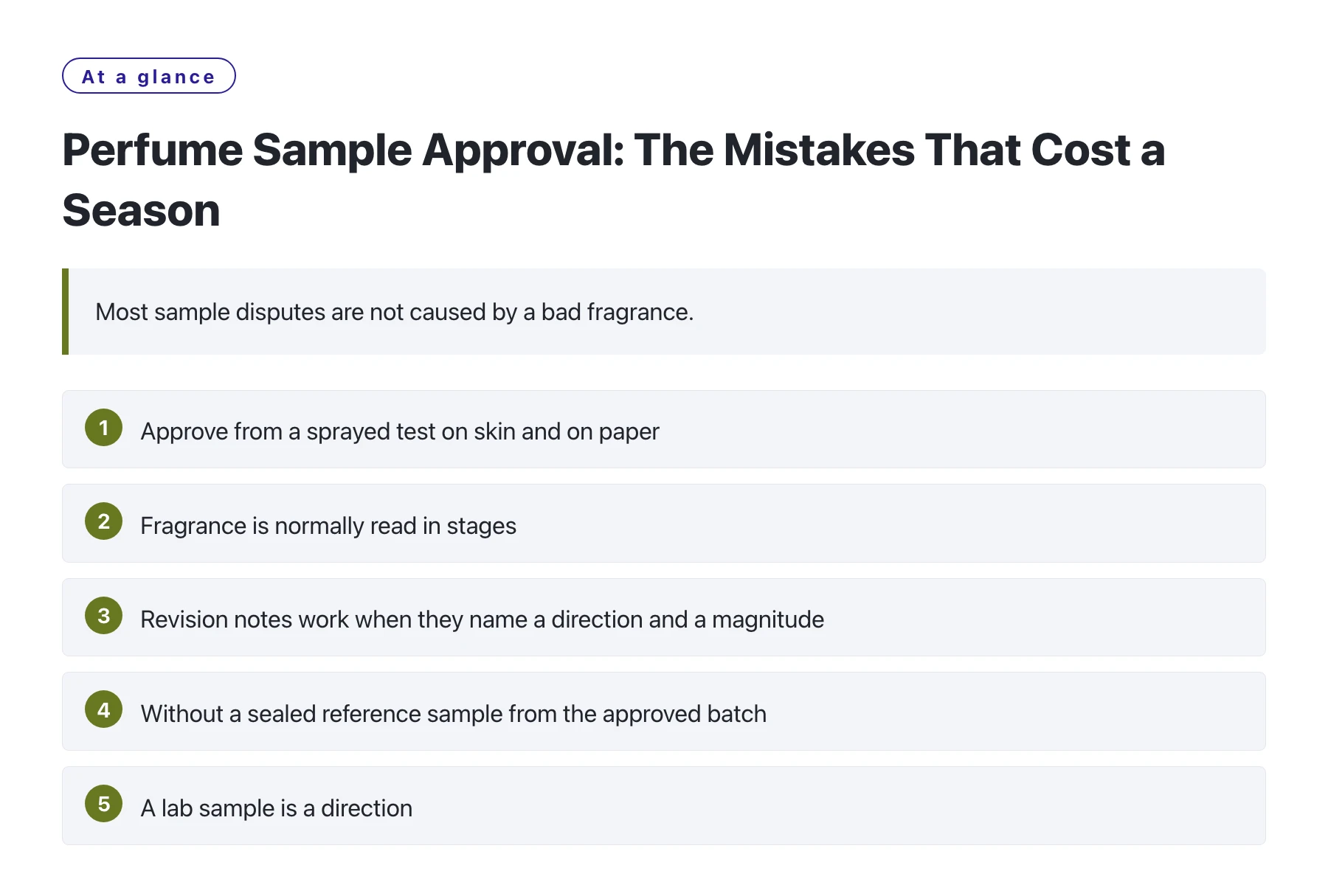
- Approve from a sprayed test on skin and on paper, read at a defined time, not from the vial and never from a photograph.
- Fragrance is normally read in stages, so the first minute and the first hour are different products; judging only the opening misrepresents the sample [1].
- Revision notes work when they name a direction and a magnitude, which is why 'less sweet in the opening' outperforms 'too strong'.
- Without a sealed reference sample from the approved batch, there is no way to prove later that the bulk order changed.
- A lab sample is a direction, not a duplicate: it is made at a different scale from the production batch and will not be bit-for-bit identical.
There is a moment in most fragrance projects when the brand and the manufacturer disagree about whether the bulk order matches the approved sample. Almost always, the disagreement was created weeks earlier, at the approval step, and only became visible at volume.
The cost of that is not just a rework. It is a launch date, a print run and, sometimes, the relationship. All three are avoidable with a process that takes about five minutes per sample and produces a written record.
What follows is written from the product development side, for someone who will have to defend an approval decision three months later.
Mistake one: approving something you never properly smelled
A fragrance is normally described in three stages, and each stage is dominated by different materials. That is why a sample sniffed straight from the vial tells you very little about what a customer will experience after twenty minutes on skin. Reading the scent at the right moment is not a formality; it is the measurement [1].
The practical protocol is unglamorous. Spray on a paper strip and on skin, note the time, and read the sample at three points: immediately, around thirty minutes, and again after a few hours. Record what you found at each point. If two people on the team are testing, test the same sample at the same time, because the comparison only holds if the conditions match.
Ask the supplier in advance how they expect a sample to be evaluated and how long it should rest, and write the answer into the brief. A manufacturer that documents its own process usually publishes the scope it works to, and https://www.xuelei.com is one example of a service page written that way; having it in writing early makes the later comparison against bulk far easier.
Blind the labels
When comparing a revision against the previous version, code the vials and hide the identities. Knowing which one is new makes people prefer it, and the whole point of the exercise is to find out what the fragrance does rather than what the team hopes it does.
Test at the same hour of the day
The nose tires. A sample tested after a morning of smelling twenty other submissions is being judged by an unreliable instrument. Two or three samples per session, a glass of water, and a break between them is enough to keep the readings usable.
Mistake two: feedback that cannot be executed
Verbal feedback is where projects lose weeks. 'It feels flat', 'it is not premium enough' and 'make it more modern' are all real reactions, but none of them tells a perfumer which material to move. The useful version of the same notes names a direction and a rough magnitude: reduce the sweetness in the opening, push the woody base forward, hold the top note where it is.
There is a second failure mode that looks like the first: treating a sample that is merely unfinished as a sample that is wrong. A first trial is usually a sketch, and asking for a rebuild when the perfumer expected a revision wastes a round. Say which parts are working and then say what to change.
One more thing worth checking before a rebuild: how long the sample has been in the bottle. If it was filled last week, part of what you are judging is time rather than composition, and it is worth understanding what changes a perfume sample over time before asking for a new formula.
Write the notes before the meeting, not during it
Send the written notes the same day you smelled the sample. Recollections diverge quickly, and a perfumer working from a two-week-old verbal summary is working from a different brief than the one you think you gave.
When a material has to change
Sometimes a note cannot simply be adjusted because a material is restricted or capped. The IFRA Standards are the reference list that fragrance houses work against, and a rebuild driven by those limits will smell different from one driven by taste [2]. Knowing which of the two you are asking for avoids an argument about the result.
Mistake three: approving without a reference
An approval that leaves no physical object behind is an opinion. Keep a sealed sample from the approved batch, labelled with the date, the batch reference and the formula code, and keep one copy at the factory and one at the brand. Every later comparison is then a measurement against a known object rather than a conversation about memory.
This is also the moment to check that the supplier has a documented approval step at all. A business built around custom fragrance R&D and production will normally be able to describe its own approval record; if yours cannot, write the requirement into the project before the next round.
The five-minute discipline that removes most disputes
- Spray the sample on skin and on paper and write the time on the strip.
- Read it immediately, at thirty minutes and at the end of the day, and record each reading.
- Code the vials before a comparison so nobody knows which version is which.
- Write revision notes as directions with a rough magnitude, and send them the same day.
- Confirm whether the sample needs more time to settle before asking for a rebuild.
- Retain a sealed reference sample from the approved batch, on both sides.
- Ask for the batch record at bulk delivery and compare it against the reference, not against a photograph.
The single highest-return habit in sample work is writing down what you smelled and when. It takes a minute, it makes the next revision faster, and it turns a later dispute into a comparison of two documented readings.
Sources
- Wikipedia: Perfume —— An encyclopaedic overview of perfume covering definitions, history, the note structure of a fragrance and concentration terminology (background reference only).
- IFRA Standards Library (International Fragrance Association) —— The IFRA Standards Library lists the restrictions the fragrance industry applies to individual fragrance ingredients, based on safety assessments; it is the reference point for compliant fragrance formulation.
Frequently asked questions
Should a sample be judged on paper or on skin?
Both, and they answer different questions. Paper shows the structure of the fragrance and is easy to keep and re-read. Skin shows how it performs with body heat and chemistry over hours. A sample that reads well on paper and dies on skin is a performance problem, not a composition problem.
How long should a sample settle before it is approved?
It depends on the formula, so ask the manufacturer rather than guessing. What matters is that the same settling time is applied to the reference and to the bulk comparison; if the sample was read at one week and the bulk at one month, the two readings are not comparable.
How many revision rounds are normal?
Two to four is ordinary for a scent developed from a written brief. The number falls when the brief is specific and the notes are directional, and rises when feedback is vague or arrives late.
Can we approve a sample by photograph or video?
For the pack and the decoration, sometimes, as long as colour is confirmed against a physical standard. For the fragrance itself, no. A photograph cannot carry a smell, and approving on one leaves nothing to compare the bulk order against.
What if the bulk order smells slightly different from the approved sample?
Some variation is normal between a lab-made trial and a production batch made at a larger scale. Decide in advance how much is acceptable by defining which characters must be present and which must not, then check the retained reference sample before you accept or reject the delivery.