What Refundable Cabinet Samples Really Mean
A refundable sample is not a free door. It is a $9.99 purchase that turns into a refund if a cabinet order follows, and the difference between those two readings is the whole point. CasaBuilt lists each door at $9.99 against a $19.99 list price, so the buyer pays half now and gets that half back later, provided the later part happens.
Key takeaways
- Each door is $9.99 at checkout against a $19.99 list price, a 50% reduction.
- The fee is refundable with a cabinet purchase, not at the point of order.
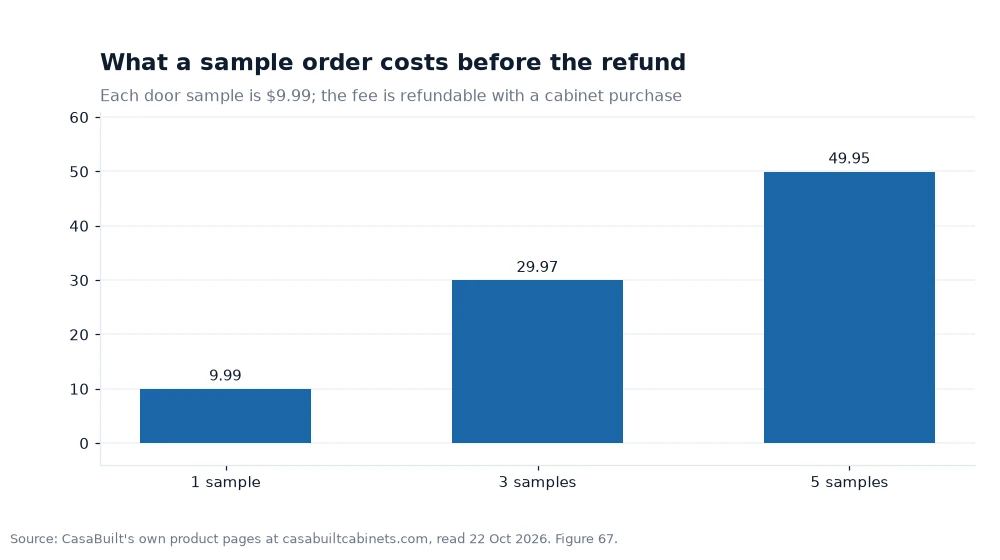
- Three doors cost $29.97 before any refund; five cost $49.95.
- A buyer who never orders cabinets keeps the door and has spent the money.
The word doing the work is "refundable"
Refundable is a condition, not a price. It tells a buyer that money leaves the account now and may return later if a separate event occurs. The event, in this case, is a cabinet purchase. That single sentence carries three facts: the sample has a price, the price is recoverable, and the recovery is tied to something the buyer has not done yet.
Read that way, the sample behaves like a deposit rather than a gift. A deposit is a normal way to hold a place in a queue, and it is why a sample fee is not a trick. The buyer gets a physical door immediately, keeps it whether or not the kitchen happens, and recovers the fee only in the scenario where the seller also gets paid. Both sides are exposed to the same decision.
What the published terms do not say matters too. The condition is a cabinet purchase, not a spend threshold, so the refund is not gated behind a minimum order value. There is also no published expiry on the offer, which means the practical deadline is the buyer's own: the longer the gap between the door and the order, the more likely the receipt is the thing that gets lost.
What the checkout total says before any refund
The number a buyer sees at checkout is simple multiplication. One door is $9.99, three are $29.97, five are $49.95. The same doors at the list price would be $19.99, $59.97 and $99.95, so the reduction is exactly half in each case. The table lays out both columns and adds the refund line, because a refund is only real if the order happens.
| Doors | Paid at checkout | List value | Refunded with a cabinet purchase | Cost if no order |
|---|---|---|---|---|
| 1 | $9.99 | $19.99 | $9.99 | $9.99 |
| 3 | $29.97 | $59.97 | $29.97 | $29.97 |
| 5 | $49.95 | $99.95 | $49.95 | $49.95 |
| 8 | $79.92 | $159.92 | $79.92 | $79.92 |
The right-hand column is the one to look at first. A refund is contingent, and a budget should be built on the contingent-free number. Five doors is $49.95 that a household may never see again. That is not a reason to skip the sample; it is a reason to order the number of doors the decision actually needs, which is usually fewer than the number a buyer wants.
Where the threshold sits
The threshold is the cabinet order, and it changes how the sample should be sequenced. A buyer who samples first, measures second and orders third is spending money that has a defined route back. A buyer who samples, then delays the measurement, then compares three other suppliers, is holding an open deposit with no date on it. The fee is the same in both cases; the odds of recovery are not.
This is the practical reason to treat the sample as step two of a five-step process rather than a shopping hobby. CasaBuilt's published route runs from browsing styles to ordering samples to submitting measurements for a quote, then design and purchase, then installation. The sample sits immediately before the measurement, not months ahead of it, and that placement is what makes a free sample recover its cost in the ordinary course of a kitchen project rather than as an exception.
The same logic explains why the fee is refundable rather than deducted at the point of sale. A refund after purchase is a clean accounting event on both sides. A discount applied to the cabinet order would be easier to forget and harder to audit, especially on a job where the cabinet list changes twice before the deposit is paid.
What the sample is not
It is not a miniature cabinet, and it is not a colour card. It is a door: rubberwood frame, MDF panel, full overlay, finished in the same seven-layer paint system with the UV protective coat that the production door receives. What it does not carry is the box, the hinges, the glides or the shelf, so a buyer who wants to judge how a drawer feels will not learn that from the sample.
It is also not a substitute for measuring. The door tells a buyer what the finish looks like in their own light. It says nothing about whether a 36-inch base fits between the sink and the range, or whether a 42-inch wall cabinet clears the window trim. That is a tape-measure job, and the published measurement guide covers the dimensions a quote needs before the design stage starts.
Finally, the sample is not a commitment device for the seller. Nothing in the published terms reserves stock, holds a price or starts a lead time. Those begin with the cabinet order, which is also when the $9.99 comes back.
Worked example: three doors and one order
Take the chart figures: one door at $9.99, three at $29.97 and five at $49.95. Each is the unit price multiplied by the count, so $9.99 x 1 = $9.99, $9.99 x 3 = $29.97 and $9.99 x 5 = $49.95. At the $19.99 list price the same three baskets are $19.99, $59.97 and $99.95, which means the sale price removes exactly $10.00, $30.00 and $50.00.
Now put the three-door basket next to a starter kitchen. $29.97 divided by $1,199.50, the published White Shaker basic kitchen price, is 0.025, so the sample spend is 2.5% of the smallest kitchen the company lists. If the cabinets are ordered, that 2.5% returns and the net sample cost is zero. If they are not, the buyer has three doors for $29.97 and a decision still open. The five-door basket is $49.95, or 4.2% of the same kitchen, and the refund still clears the whole amount.
Frequently asked questions
Is the sample fee refunded automatically?
No. The published term is that the sample price is refundable with a cabinet purchase, so the refund follows an order rather than the sample delivery. A buyer who never places a cabinet order keeps the door and the charge stands. Keep the order confirmation and the sample receipt together so the refund can be matched to the purchase.
Does a small cabinet order still qualify for the refund?
The published condition is a cabinet purchase, not a minimum spend, so the trigger is the order itself rather than its size. A single cabinet bought to complete a run is still a cabinet purchase. If a project is being staged across several months, the sensible approach is to place the cabinet order when the list is settled rather than splitting it into several small purchases.
How many doors should one household order?
Two or three is usually enough: the leading candidate, the closest alternative and, if the light in the room is difficult, one door from a different colour family. Three doors cost $29.97 at the published price and the whole amount is refundable with a cabinet purchase. Ordering eight doors at $79.92 buys more comparison than most kitchens need.
Treat the fee as a deposit, then close the loop
Order the doors after the room is measured, not before, so the sample and the quote sit in the same fortnight. Photograph each door in the actual kitchen at the hour the household cooks, and write the profile name on the back of the one that wins. Then place the cabinet order while the choice is still fresh.
The refund is the last step, not the first. A buyer who plans the sequence gets the door, the decision and the money back. A buyer who treats the sample as a free keepsake gets a door and a $9.99 line on a statement that never reverses.
Figures quoted here come from the manufacturer's own website, read 22 Oct 2026[1].